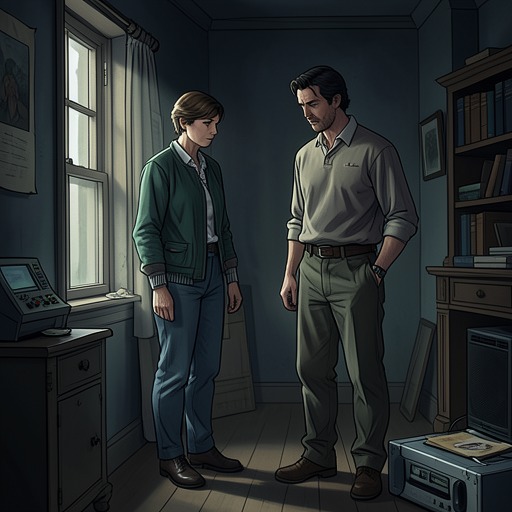
Jake ends his pursuit of Helen
Happiness for BeginnersJake ends his pursuit of Helen not because he denies his desire, but because he decides that acting on it would be selfish. The scene turns on that contradiction: he wants to continue, yet withdraws; Helen demands an explanation, yet receives silence; and their final handshake formalizes a separation neither can make emotionally real. Told through Helen’s perspective, the encounter makes rejection and attachment coexist rather than resolve one another.
Background and the Pause
Jake and Helen have been close enough the previous day that Helen imagines resuming where they left off. But an hour has passed, and the interval has changed the scene. She recognizes that time to think has affected them both: she has been on the phone with her ex-husband, while Jake has been alone with his thoughts. The pause is not presented as a change in attraction so much as an opportunity for Jake to reconsider what pursuing Helen would mean.
When Helen asks whether they should pick up where they left off, Jake keeps his eyes on his book. The small refusal to meet her gaze contrasts with the intimacy she is proposing. Helen reads his hesitation quickly and names what she sees: he does not want to continue. Jake corrects her, saying that he does want to, “You have no idea.” His admission makes the withdrawal more difficult to interpret as simple disinterest; the conflict is between desire and his judgment about acting on it.
Jake’s Decision to Withdraw
Jake says that he should never have started and calls his behavior selfish. Helen answers that he should be selfish and that she does not care, but Jake insists that she should care: “You don’t need another selfish man.” The remark places her past marriage at the center of his reasoning. Helen understands that Duncan has told Jake about Mike, and she points to the difficult year—or six years—behind her as a reason she should be allowed to have some fun. Jake’s answer, “Not with me,” turns his concern into a personal refusal, even while his earlier admission confirms that he wants her.
Asked what has changed, Jake says that he has had too much time to think. Helen sets his withdrawal against the course of their connection as she understands it: he has flirted with her since Boston, promoted himself to her, and looked at her with unmistakable interest. Now, she says, he is shutting everything down. Jake responds that he has to. His explanation remains spare, but the scene establishes the terms of his choice: he will not pursue what he wants because he believes Helen deserves someone better and fears becoming another selfish man in her life.
The Demand for an Explanation
Helen cannot reconcile Jake’s earlier conduct with his sudden decision. She paces, moving to the window and back, and notes that there is nowhere else to go. When Jake tells her she is beautiful, the compliment does not soothe her; it intensifies her anger because it leaves the central question unanswered. She demands that he explain what is happening in simple words, warning that without an explanation they are done and she does not want him to speak to her.
Jake looks down and seems anxious, nervous, or overwhelmed to Helen. He stares at nothing for several minutes, then meets her eyes without speaking. The silence becomes consequential: Helen waits as long as she can bear, sees disappointment on her own face, and ends the exchange. She says she hopes Jake and Duncan will laugh about the episode together. Jake replies that it is not like that and promises he will never tell Duncan. Helen registers sadness in his voice and sees his shoulders slump, but his distress still does not supply the explanation she demanded. The scene therefore lets his emotional reaction show that the separation matters while withholding any fuller account of what he cannot bring himself to say.
Rejection Reversed and Made Formal
The next exchange converts the unresolved hurt into an attempt at self-protection. Helen tells Jake that the previous day does not matter, but admits that four hours spent pretending not to care have not relieved her humiliation, rejection, or sense of being pathetic. She frames the response as an effort to become a badass superhero rather than feel like a sniveling teenybopper. Then she tells Jake, “I never really liked you,” and adds that she wishes the previous day had never happened.
Jake answers that he wishes it had never happened, too. His agreement appears to confirm the rejection Helen has just performed, but its effect is not reassuring: hearing her own words returned to her stings. She makes her voice falsely bright and insists that they agree. The exchange exposes the difference between saying the past should be erased and actually being free of it. Neither character offers an honest reconciliation in this moment; instead, they try to make a painful encounter manageable by declaring it invalid.
The Stranger Agreement
Helen proposes pretending to be strangers, and Jake asks whether that is what she wants. She says she wants them to pretend so hard that they almost believe it. Jake takes a deep breath, looks into her eyes as if deciding something about her, and agrees: “I’ll pretend for you, Helen,” he says, while adding that there is no way he will believe it. His answer accepts the performance but refuses its premise. He can comply with distance for Helen’s sake; he cannot convince himself that their connection has disappeared.
The handshake gives the separation a concrete ending. Helen sticks out her hand and calls it goodbye; Jake looks at it before taking it, and they shake. That formal gesture contrasts with the intimacy and hurt that have filled the conversation. The event closes not with a repaired relationship or a settled explanation, but with an agreement whose emotional limit Jake has already named. His pursuit stops, while his attachment remains legible in his desire, his distress, and his refusal to believe they are strangers.